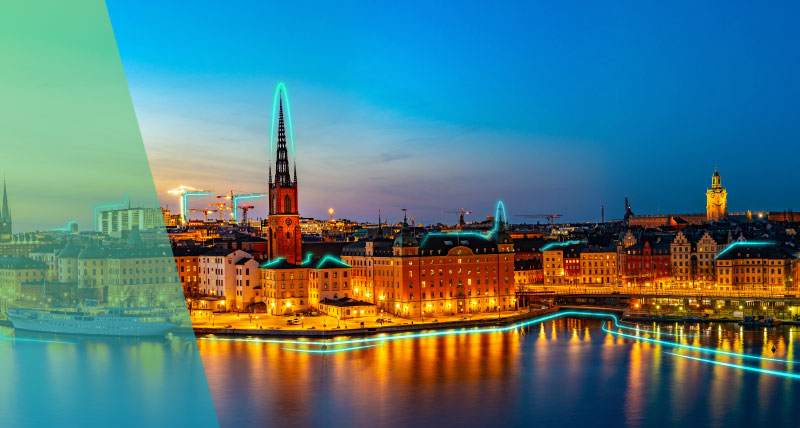












In the heart of Switzerland, the Canton of Zug has launched ZugTwin, a modern urban digital twin project.
What is an urban digital twin?
It’s more than a 3D model. It integrates mature technologies to offer unprecedented insights and actionable information and can help your city reach its sustainability goals.
Get to know Zug
Zug is one of Switzerland’s most economically powerful regions and is internationally established as a major financial and trading center. This positive economic development is based on modern infrastructure and a high quality of life. The Canton purposefully promotes innovation and entrepreneurship, reflected by a large number of startups and technology companies. This innovative strength and a consistent digital strategy support diversification and sustainable stability of the regional economy. With its “Digital Zug” strategy, the Canton pursues ambitious goals for further digitalization of administration and the development of contemporary services.
The ZugTwin digital twin project was realized through collaboration among the leading Office for Land Register and Geoinformation, the Office for Monument Preservation and Archaeology, the Office for the Environment, Hexagon in Switzerland and Lucerne University of Applied Sciences and Arts. ZugMap, the Canton’s existing public geoportal, served as the foundation for the 3D digital twin, designed to make geodata accessible, interactive and understandable in 3D for the public using it.
How can your city get started?
How do you get started? And what does it take to be successful? Below are some frequently asked questions, with answers from Hexagon experts.
- What is an urban digital twin, and how can it benefit local government operations?
An urban digital twin is a dynamic digital replica of a city, integrating advanced technologies to provide actionable insights. It goes beyond a simple 3D model leveraging data to monitor and analyze city operations like infrastructure and traffic. It enables informed decision-making, improved efficiency and enhanced public safety. It also fosters collaboration among city departments by providing a unified platform for data sharing and communication.
- What are the initial steps required to implement an urban digital twin in our municipality?
Start by identifying the specific use cases where it can add value, such as traffic management or infrastructure monitoring. Next, gather and organize the necessary data, including geographic information, sensor inputs, simulations and existing city records. Choose a platform or partner, like Hexagon, that can integrate these data sources into a cohesive urban digital twin.
- How can an urban digital twin improve resident engagement and service delivery?
Urban planning can be presented virtually, enabling informed feedback. This transparency allows residents to actively participate in city development. Real-time data and predictive insights improve service delivery, coordinating departments and minimizing disruptions. Ultimately, visual, data-driven communication builds trust and leads to more engaged citizens.
- How does an urban digital twin support sustainability and environmental management in cities?
It allows a city to simulate scenarios like greening spaces to reduce temperatures and improve air quality, optimizing building layouts to maximize ventilation and detecting and addressing heat islands to enhance livability. It can also identify flood risks so proactive measures can be taken. These insights help cities make strategic decisions for a healthier, more sustainable environment.
- What are the cost considerations for developing an urban digital twin?
Costs involve technology infrastructure, data acquisition and maintenance. Automated data handling is critical for an up-to-date data foundation, making sustainable urban digital twin operations possible. Investing in expert guidance helps identify valuable data sources, ensure integration and implement automation strategies. A proof of concept based on existing data can demonstrate benefits and refine your approach. Strategic planning and expert insights, focused on data automation, help cities optimize costs and fully realize the potential of urban digital twins.

Christophe Plevoets is a product marketing manager specializing in geospatial solutions at Hexagon. He has been a pivotal team member since 2018. He has a rich background as a customer consultant, presales specialist and business development engineer, and he has honed his expertise in geospatial technologies and strategies. His diverse roles have equipped him with a comprehensive understanding of customer needs and market dynamics. This enables him to drive innovative marketing initiatives that enhance Hexagon’s geospatial offerings. Passionate about leveraging cutting-edge geospatial technology, Christophe is dedicated to empowering businesses to make informed, data-driven decisions.
Related posts
Cities can leverage DaaS to address urban heat islands and airflow
How did Klagenfurt, Austria, realize carbon savings of 14,000 tons of avoided CO2 emissions?
Stuttgart, Germany: Powering smarter decisions with an urban digital twin